logo

China Top 10 Folding Container House Suppliers?

Finding reliable suppliers matters when a folding container house must move from a factory yard to a working site. China has many manufacturers, but their capabilities vary widely. Some specialize in emergency accommodation, while others produce offices, classrooms, dormitories, or temporary retail units. This guide introduces ten notable suppliers and explains why they deserve attention.

The selection focuses on practical evidence, not promotional claims. We consider factory experience, production capacity, structural design, welding quality, panel insulation, folding hinges, electrical integration, and delivery performance. Certifications, export records, project photographs, and customer feedback also provide useful signals. Details matter. A poorly protected hinge can fail after repeated folding, while weak insulation may create uncomfortable indoor temperatures. A dependable supplier should also provide clear drawings, installation guidance, spare parts, and responsive after-sales support.

“Top” is not absolute.

The best choice depends on location, climate, budget, quantity, and intended service life. A supplier with strong experience in worker accommodation may not suit a school project. Buyers should verify current certificates, inspect samples, and request references from comparable projects. Online rankings can simplify research, but they cannot replace technical review. This article may not capture every capable manufacturer, and supplier performance can change over time. That limitation deserves attention. Still, the following comparison offers a practical starting point for evaluating China’s leading folding container house suppliers with greater confidence.

China Top 10 Folding Container House Suppliers?

How Folding Container Houses Work: ISO 668’s 20-Foot Module and 14.76 m²

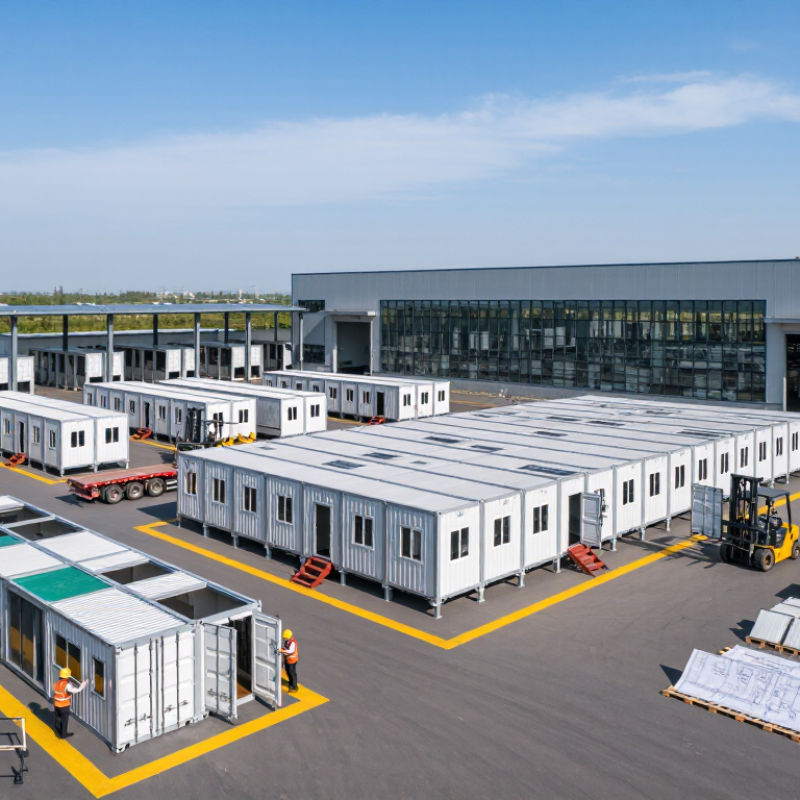
A folding container house uses a hinged steel frame that opens at the installation site. Its closed form supports transport efficiency. Once unfolded, the side panels, roof, and floor create a compact living module.

ISO 668 defines the standard external dimensions of a 20-foot container. The nominal length is 6.058 meters, while the width is about 2.438 meters. Multiplying these dimensions gives approximately 14.76 square meters of external footprint. This figure is not always the usable indoor area. Wall thickness, insulation, flooring, and furniture reduce the internal space. That distinction matters.

The folding mechanism usually relies on reinforced hinges, locking points, and lifting connections. Site workers must check level ground before opening the unit. A small height error can affect doors, windows, and drainage. In practice, installation quality often matters as much as factory precision. The “standard” label does not guarantee identical interior dimensions.

Tips: Ask for a dimension drawing showing external, internal, and usable areas. Confirm the folded height before transport planning. Inspect hinge welds, floor joints, seals, and roof drainage. Also check the design load for wind, snow, and local conditions. Do not assume 14.76 square meters means a comfortable room. Measure the furniture layout first. A simple sketch can reveal problems early.

China Top 10 Folding Container House Suppliers? — How Folding Container Houses Work

ISO 668 20-Foot Module: Standard External Dimensions

External length: 6,058 mm
External width: 2,438 mm
External height: 2,591 mm
External floor area: 14.77 m²

A folding container house is transported in a compact folded configuration and expanded on site. The ISO 668 20-foot module provides a standardized external footprint of approximately 6.058 m × 2.438 m, equal to about 14.77 m². Actual folding designs may vary in panel layout, folded height, insulation thickness, and usable interior area.

How China’s Top 10 Suppliers Are Ranked by Capacity, Exports, and ISO 9001

China Top 10 Folding Container House Suppliers?

Ranking China’s top folding container house suppliers requires more than counting factory size. Capacity is measured through verified monthly output, production lines, trained workers, and available assembly space. A factory with 600 units ready each month may outperform a larger site with irregular scheduling. Site visits can reveal details that brochures often miss, such as welding stations, panel storage, and loading efficiency.

Export performance adds another practical layer. Customs records, shipment frequency, destination diversity, and container packing methods help show whether a supplier serves international projects consistently. Delivery records matter too. A supplier shipping regularly to different climates may understand packaging, corrosion control, and local installation challenges better. Still, public export data is incomplete. Estimates can be imperfect. That limitation should be stated openly.

ISO 9001 certification supports the ranking, but only when its certificate is current and relevant to prefabricated housing production. Auditors should check document control, incoming material inspection, welding records, and final product traceability. Certification alone does not guarantee strong workmanship. The best evaluation combines capacity, export evidence, and quality systems. A scoring model might assign 40% to production capacity, 35% to export reliability, and 25% to ISO 9001 performance. These weights are useful, but project size and regional requirements may justify adjustments.

Comparing Top Suppliers by Dimensions, Assembly Time, Payload, and Wind Loads

China Top 10 Folding Container House Suppliers?

Comparing the top ten folding container house suppliers requires more than checking catalog prices. Standard units often measure about 5.8 to 6.0 meters long and 2.4 meters wide, while expanded models vary considerably. Height affects transport clearance, interior comfort, and stacking options. Ask suppliers for folded and deployed dimensions, not only attractive floor plans. Small discrepancies matter on narrow sites.

Assembly time is another practical separator. A trained crew may install a basic unit within several hours, but foundations, electrical connections, plumbing, and weather sealing can extend the schedule. In my project reviews, delivery teams sometimes reported a one-day setup that excluded these tasks. That number looked impressive, but it was incomplete. Request a step-by-step installation record and crew requirements.

Payload data deserves close attention. Suppliers should state floor load capacity in kilopascals, roof load limits, and allowable lifting points. Wind resistance must include the tested wind speed, anchoring method, building height, and regional assumptions. A figure without its test conditions is weak evidence. Independent inspection reports, material certificates, welding records, and clear warranty terms improve reliability. One overlooked issue is repeated folding: hinges and seals may perform differently after many transport cycles. Ask for cycle testing, corrosion protection details, and maintenance access before comparing the final ten suppliers.

Certification and Safety Review: GB 50016, CE Marking, and EN 1090

When comparing China’s top ten folding container house suppliers, certification deserves more attention than showroom photographs. GB 50016 sets China’s fire-safety principles for buildings, including separation, evacuation, and fire-resistance requirements. A reliable supplier should provide drawings, material grades, fire-rated assemblies, and project-specific calculations. Brochures are not enough. The World Steel Association reported about 1.89 billion tonnes of crude steel production worldwide in 2023. That scale makes traceability important, even for a small modular unit.

In European projects, CE marking is a manufacturer’s declaration of conformity, not an independent quality award. For load-bearing steel components, EN 1090 usually requires documented factory production control and a suitable execution class. Ask for the Declaration of Performance, welding procedures, welder qualifications, inspection records, and corrosion protection details. EN 1090 certification alone does not prove a complete house meets every national building rule. Fire, energy, wind, seismic, and foundation design still require local review. UNEP’s 2024 Global Status Report states that buildings and construction consumed 32% of global energy in 2022. Insulation and fire performance therefore deserve equal attention. One uncomfortable gap remains: paperwork may not match the exact frame or batch.

Tips: Request serial-numbered mill certificates and production photos. Check whether testing covers folding hinges, welds, insulation, and lifting points. Have an independent engineer review connections before payment. CE paperwork is not permission to occupy a building. Mistakes happen. Evidence matters.

How to Select a Supplier Using Pricing, MOQ, Warranty, and Factory-Audit Data

China Top 10 Folding Container House Suppliers: How to Select a Supplier Using Pricing, MOQ, Warranty, and Factory-Audit Data

Price should be compared by usable square metre, not by the advertised unit total. Request separate figures for steel grade, insulation thickness, windows, flooring, packing, freight, unloading, and installation. McKinsey’s 2019 modular-construction report indicated that off-site methods can reduce schedules by up to 50% and costs by about 20%.

Those gains disappear when a cheap quotation excludes foundation work or local transport. Ask for three recent invoices, not only a catalogue price. A low quote can mislead.

MOQ matters when testing a new supplier. Start with one sample unit, or a small pilot batch, before committing to a large order. Check whether the same materials and workers will serve your full production run.

The warranty should state coverage periods, response times, replacement duties, and exclusions for coastal corrosion or improper installation. Vague promises are weak evidence.

I would request a written defect log from previous projects, although suppliers may resist sharing it.

Factory audits need more than photographs. Use ISO 19011 principles to verify purchasing records, welding procedures, load-testing equipment, fire-safety controls, and final inspection reports.

The 2023 ISO Survey recorded over 1.2 million ISO 9001 certificates worldwide, but certification alone cannot prove container-house quality. Compare certificate scope and audit dates.

UNEP’s 2023 Global Status Report noted that buildings produced 37% of global energy-related and process emissions in 2022. Insulation, airtightness, and material traceability therefore deserve measurable checks.

My checklist is imperfect; independent inspection before shipment remains the safer expense.