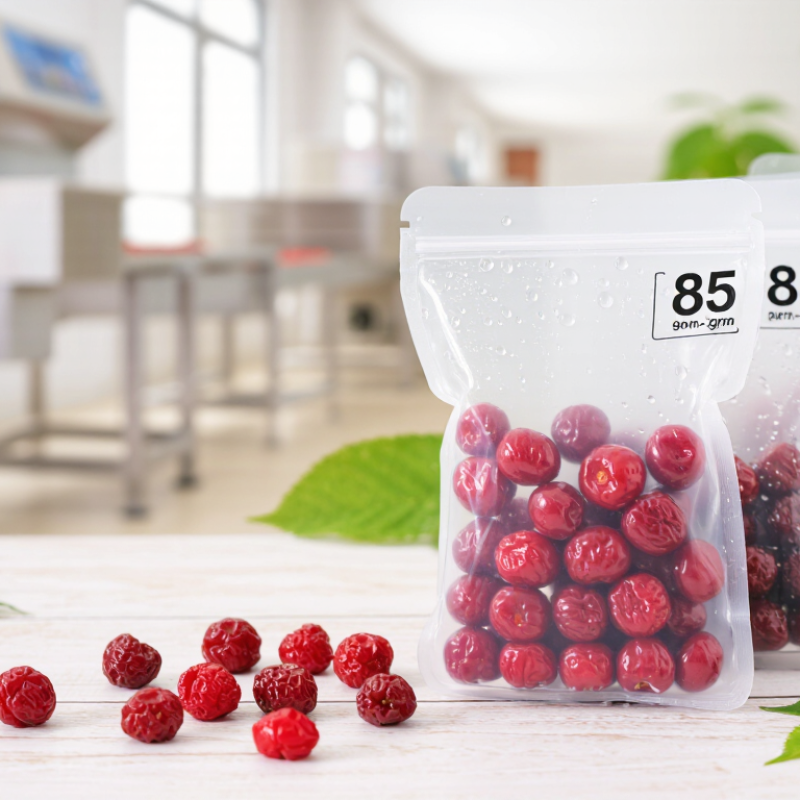
| U100 Pack Definition | Net content is below 100 g; 85 g is 15 g below the U100 threshold. | Approved artwork, product specification, and production-weight records. | Confirms that the product is correctly positioned as a compact, under-100-g retail format. |
| Pack-Size Accuracy | Declared net weight: 85 g; a 12-pack case contains 1,020 g of product before packaging weight. | Checkweigher calibration records, sample-weight reports, and lot traceability. | Reliable filling control helps maintain legal net-content compliance and customer confidence. |
| Product Identity | Dried cherries, with the cherry variety, sweetener use, oiling, and preservative status clearly specified. | Ingredient specification, allergen statement, and product technical data sheet. | Prevents ambiguity between sweetened, unsweetened, sulfited, and differently processed products. |
| Moisture and Texture | Moisture target should be defined by the manufacturer for the intended soft, chewy, or semi-dry texture; no single moisture value applies to every dried-cherry style. | Product specification, moisture test method, water-activity results, and retention samples. | Controlled moisture supports consistent texture and helps manage microbiological and shelf-life risks. |
| Ingredient Transparency | The ingredient list should identify cherries and any added sugar, juice concentrate, vegetable oil, or sulfur dioxide. | Current ingredient declaration and laboratory verification where required. | Clear formulation information supports regulatory compliance and accurate buyer claims. |
| Sulfite Control | If sulfur dioxide or sulfiting agents are present, declaration requirements depend on the destination market; in the United States, sulfites at 10 ppm or more generally require declaration. | Sulfite analysis, treatment records, and market-specific label review. | Demonstrates control of a regulated additive and reduces labeling risk for sensitive consumers. |
| Food-Safety System | A documented HACCP-based system or a recognized food-safety management system such as ISO 22000:2018 is expected for professional supply. | Valid certificate, audit scope, corrective-action history, and preventive-control plan. | Shows that hazards are identified, controlled, monitored, and reviewed systematically. |
| Microbiological Testing | Testing should be risk-based and may include yeast and mold, total plate count, coliforms, and pathogen testing according to the buyer’s specification. | Recent lot-specific certificates of analysis from a competent laboratory. | Independent results provide evidence that finished products meet agreed safety limits. |
| Foreign-Material Control | Sorting, sieving, magnets, metal detection, or X-ray inspection should be selected according to the process risk. | Equipment validation, challenge-test records, and inspection logs. | Effective controls reduce the risk of stones, stems, metal, glass, or other physical contaminants. |
| Grade and Appearance | The specification should define size distribution, color range, broken pieces, stems, pits, scorch, and visible defects. | Reference sample, defect limits, grading procedure, and batch inspection report. | A clear visual standard improves consistency across production lots and retail presentations. |
| Packaging Barrier | The pouch or sachet should provide suitable protection against moisture, oxygen, light, and physical damage for the declared shelf life. | Packaging material specification, seal-strength results, migration compliance, and shelf-life study. | Barrier performance helps preserve texture, color, flavor, and food safety during storage and transport. |
| Label Compliance | The label should include product name, net quantity, ingredient list, allergen information where applicable, nutrition facts, lot code, date marking, and responsible operator details as required by the destination market. | Market-specific label proof and regulatory compliance review. | Accurate labeling is essential for legal sale and informed consumer choice. |
| Traceability | Each 85 g unit should be linked to a lot code covering raw material, processing date, packaging line, and finished-product release. | Mock-recall report and one-step-back/one-step-forward traceability records. | Fast traceability supports targeted corrective action and efficient recalls when necessary. |
| Commercial Capability | A suitable supplier should confirm minimum order quantity, lead time, packaging options, annual capacity, and export documentation for the 85 g format. | Production plan, capacity statement, sample approval process, and shipment records with sensitive commercial details removed. | Operational capacity determines whether the manufacturer can deliver consistent quality at the required scale. |


 Your message must be between 20-3,000 characters!