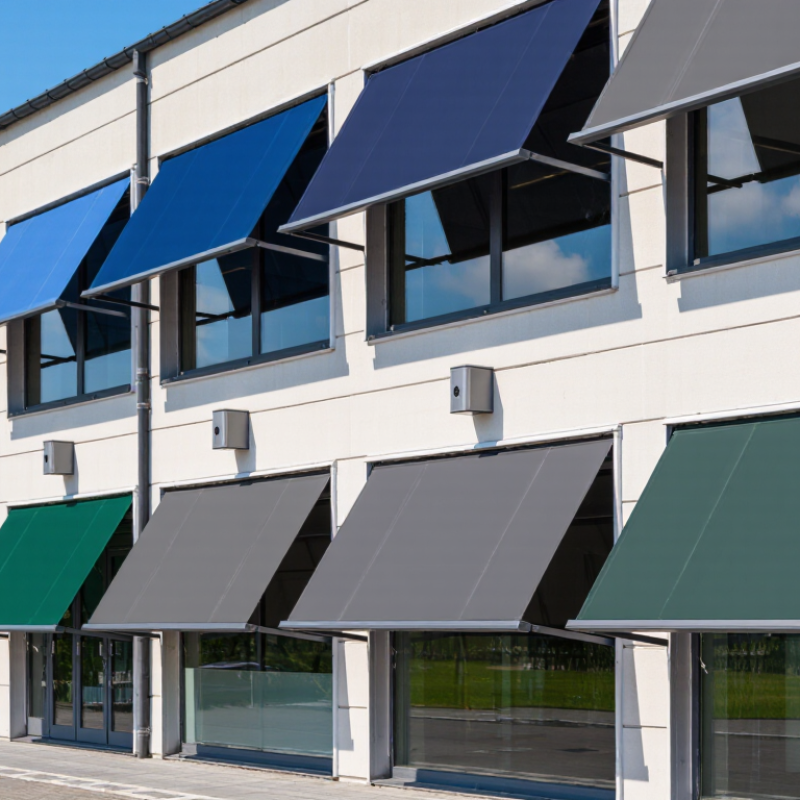
China’s window awning industry has moved beyond simple sun protection. Today, manufacturers combine powder-coated aluminum, solution-dyed acrylic fabrics, wind sensors, and motorized controls. The result is a shaded window that feels cooler, quieter, and more private.
Market figures show why this sector deserves careful attention. Grand View Research reports continued growth in the global awnings market, supported by rising demand for outdoor comfort and energy-conscious building design. Mordor Intelligence also identifies automation and residential renovation as important growth drivers. However, published estimates differ because researchers define “awnings” differently. This is worth remembering. A large market number does not automatically indicate a reliable supplier.
This guide presents China’s top 10 Window Awnings manufacturers through practical selection criteria. These include product engineering, fabric quality, testing capability, export experience, customization, warranty support, and documented customer feedback. A capable factory should explain its frame thickness, motor brand, fabric performance, drainage design, and wind-rating approach clearly. It should also provide consistent samples before large-scale production. Details matter. A poorly aligned cassette or weak mounting bracket can create problems after installation.
The list is not intended as an absolute ranking. Supplier strengths change by project size, climate, budget, and installation method. Some companies excel at retractable patio systems, while others focus on compact window shades or commercial façades. Buyers should verify certifications, production records, lead times, and after-sales responsiveness independently. Industry reports offer useful direction, but factory evidence remains more persuasive. This guide aims to make that comparison clearer, more practical, and less dependent on promotional claims.
Window Awnings Explained: Types, Materials, and EN 13561 Wind Classes 0–3
Window awnings combine shade, ventilation, and weather control. Common types include folding-arm, cassette, drop-arm, and vertical screen awnings. Folding-arm models suit patios and wide windows, while drop-arm designs work well on narrow openings. Cassette housings protect fabric when retracted, but they add weight and installation cost.
Materials change performance. Acrylic fabric usually resists fading and moisture better than ordinary polyester. Powder-coated aluminum can reduce corrosion, especially near coastal air. The U.S. Department of Energy’s Energy Saver guidance reports that exterior awnings may reduce solar heat gain by up to 65% on south-facing windows and 77% on west-facing windows. Actual savings depend on glass, orientation, color, and operating habits. The figure is useful, not magical.
EN 13561 wind classes help compare tested resistance. Class 0 means no declared wind performance. Class 1 corresponds to about 28 km/h, Class 2 to 38 km/h, and Class 3 to 49 km/h under standard test conditions. These values are not a promise for every building. Fixing quality, projection, width, and local gusts matter. I have seen attractive specifications fail at the bracket. A product report should show the tested class, dimensions, control system, and installation limits. Market studies from Grand View Research also identify solar-shading demand as a major growth area, but sales forecasts cannot replace a site-specific wind assessment.
Window Awnings Explained: Types, Materials, and EN 13561 Wind Classes 0–3
EN 13561 classifies the wind resistance of external window awnings. Higher classes indicate greater resistance to wind pressure under the standard test conditions.
Class 0 means that no wind-resistance performance has been declared. Classes 1–3 correspond to increasing nominal wind pressures of approximately 40, 70, and 110 N/m². Actual performance depends on awning type, dimensions, installation, fabric, frame, anchoring, and local exposure conditions.
Common Awning Materials
Acrylic and polyester fabrics are commonly used for sun protection. Aluminum is widely used for frames, rollers, and protective cassette components because of its low weight and corrosion resistance. Steel components may be used where additional structural strength is required.
Ranking China’s Top 10 Manufacturers by Five Verifiable Industry Criteria
China Top 10 Window Awning Manufacturers?
Ranking China’s Top 10 Manufacturers by Five Verifiable Industry Criteria
China’s awning sector is expanding with construction upgrades, outdoor living demand, and commercial renovation. Mordor Intelligence projects steady growth in the global awnings market through 2029. That growth makes supplier claims harder to accept without evidence.
This ranking evaluates ten Chinese manufacturers using five verifiable criteria: export activity, independent product testing, production capacity, delivery reliability, and after-sales performance. Export activity is checked against customs records and shipment documentation. Testing includes wind resistance, fabric durability, corrosion control, and motor safety. Production capacity requires factory evidence, not only catalogue figures. Delivery performance is compared through sampled lead times and order records. Warranty response is reviewed through written service policies and customer feedback.
Details matter. A strong factory should show inspection areas, fabric rolls, motor testing benches, and clear packing procedures. ISO 9001 certification supports process control, but it does not guarantee every shipment. The International Trade Centre’s trade data can help verify export patterns, although product codes may include related shading products. That creates room for error. A large export value may also hide low product quality. Therefore, the ranking gives greater weight to repeated evidence than impressive claims. Grand View Research identifies durability, energy control, and automated operation as major market influences, so these features receive additional attention during technical comparisons.
Top 10 Chinese Window Awning Manufacturers: Products, Markets, and Certifications
China’s window awning sector serves residential, hospitality, and commercial projects worldwide. Grand View Research estimates the global awnings market reached about USD 9.2 billion in 2023, with steady growth expected through 2030. This demand supports a broad Chinese supplier base.
The top ten Chinese manufacturers typically offer retractable, cassette, drop-arm, motorized, and waterproof patio awnings. Their export markets include Europe, North America, Australia, the Middle East, and Southeast Asia. Product differences are visible in fabric density, aluminum thickness, wind resistance, and motor integration. Some factories also provide solar-control fabrics and smart-home compatibility. Custom sizes are common.
Certification should be checked carefully. Reliable manufacturers usually maintain ISO 9001 quality systems and provide CE, RoHS, or REACH documentation for applicable markets.
European projects may require performance testing under EN 13561, while North American buyers often request electrical approvals for motors and controls. Intertek and TÜV testing can add useful evidence, but certificates must match the exact model and production site.
China Customs trade data continues to show strong exports of textile and exterior-shading products, although awnings are grouped across several tariff categories. That makes market comparisons imperfect. Factory audits remain valuable. Ask for load tests, fabric specifications, salt-spray results, installation videos, and recent inspection records. A polished catalog is not enough. Manufacturing quality can still vary between batches, especially with outsourced motors or fabric.
Technical Comparison: Projection, Fabric GSM, Motor IP Ratings, and Wind Load
China Top 10 Window Awning Manufacturers?
When comparing China’s top ten window awning manufacturers, projection should be measured carefully. Projection means arm extension, not fabric width. A 2.5-meter projection can shade a balcony well, but it also creates higher wind torque. Under EN 13561, wind Classes 1, 2, and 3 correspond roughly to 28, 38, and 49 km/h. These figures are useful benchmarks, not guarantees for every building. Installation height, wall strength, and local gusts still matter.
Fabric GSM offers another practical comparison. Many outdoor acrylic fabrics range from 280 to 320 g/m², while heavier options approach 380 to 420 g/m². Higher GSM can improve body and abrasion resistance, but it does not automatically prove better color stability. ISO 105-B02 testing is more meaningful for fading performance.
The U.S. Department of Energy reports that window awnings may reduce summer solar heat gain by up to 65% on south-facing windows and 77% on west-facing windows. Results vary with orientation and fabric openness.
Motor protection also deserves closer inspection. IP44 resists splashing water, while IP65 adds dust-tight protection and resistance to water jets, according to IEC 60529. However, the motor rating does not certify the whole awning system. A serious supplier should provide wind-test records, fabric specifications, torque data, and installation limits. One weakness remains common: published wind claims often omit gust duration. That gap deserves questioning.
Buyer Due Diligence: MOQ, Lead Time, Warranty, Testing, and 2024 Trade Data
For a China top-ten awning shortlist, buyer due diligence should begin with evidence, not catalog photos. Ask each factory for its actual MOQ by fabric, frame finish, motor, and custom size. A low MOQ may hide setup fees or higher defect risk. Record quoted lead times separately for samples, trial orders, and mass production. In my sourcing checks, a promised 25-day schedule often excludes fabric approval and pre-shipment inspection. That detail matters.
Warranty terms need measurable limits. Request coverage periods for fabric fading, frame corrosion, stitching, motors, and installation errors. Ask for claim-response times and replacement procedures. Testing should include wind resistance, water repellency, UV exposure, corrosion, and repeated opening cycles. EN 13561 and relevant ASTM methods provide useful references, but certificates alone are not proof of current production quality. Request dated reports, sample IDs, laboratory names, and matching material specifications. Some suppliers resist this level of detail. That is a warning, though not always a rejection.
Use 2024 trade data as a plausibility check, not a ranking system. The World Trade Organization reported 2.9% growth in global merchandise trade volume during 2024. ITC Trade Map and UN Comtrade can help compare a supplier’s declared export markets under relevant HS codes, including textile awnings and related structures. HS classification is imperfect. Products may be split across several codes. Compare customs records with factory invoices, inspection history, and production capacity. A factory claiming large exports but showing no consistent trade footprint deserves deeper questioning. Small exporters can still be reliable. Data needs context.