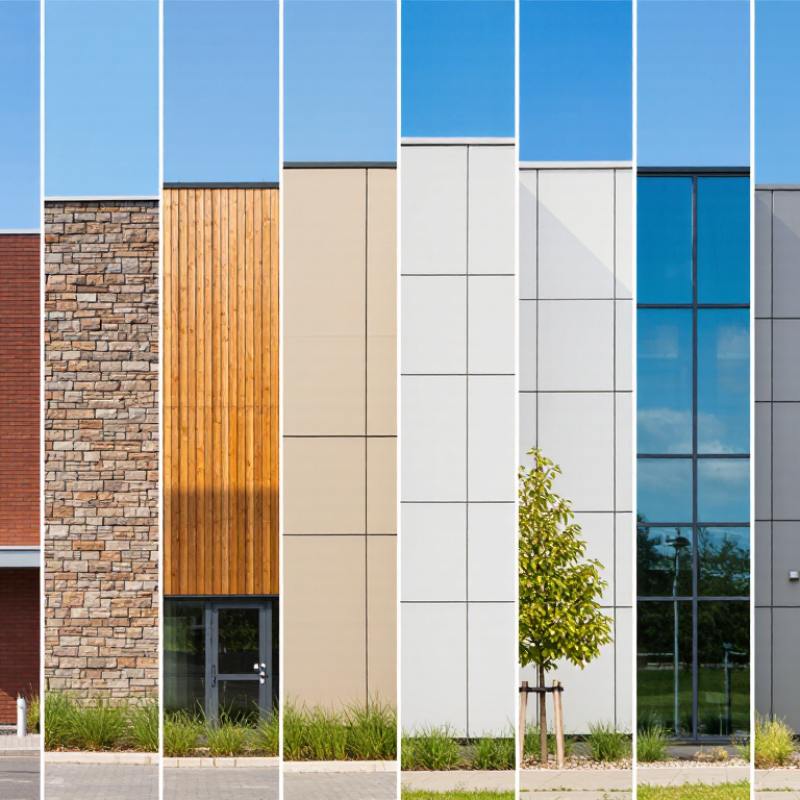
| 1 | Fiber-Cement Panels and Siding | Pressed cement, cellulose fiber, mineral fillers; available as lap siding, planks, panels, and rainscreen boards. | Often Class A
Many fiber-cement products have low flame-spread characteristics, but the tested result must be confirmed for the exact product and finish. ASTM E84 classification is generally Class A when flame spread is 0–25 and smoke developed is 0–450. | Use project-specific design pressures calculated under ASCE 7 or the applicable national wind code. Verify panel span, fastener spacing, substrate capacity, clip strength, and tested pressure resistance for the complete assembly. | Typically installed as a drained and ventilated rainscreen. Confirm compliance using system testing such as ASTM E331 or AAMA 501.1, together with properly designed flashings, joints, and air barriers. | Commonly available
Product-specific EPDs may report global warming potential, primary energy, water use, and other life-cycle indicators under ISO 14025, ISO 21930, or EN 15804. |
| 2 | Metal Panels | Aluminum, galvanized steel, zinc, or stainless-steel panels; formed as corrugated sheets, cassette panels, planks, or interlocking systems. | Usually Class A
Metal itself is generally noncombustible or has very low flame-spread contribution. Paints, coatings, insulation, sealants, and composite cores can change the assembly result. | Wind performance is highly dependent on panel profile, span, pressure equalization, clips, fasteners, and support framing. Require structural calculations and tested system capacities for positive and negative pressures. | Specify a drained cavity, pressure-equalized joints where applicable, compatible gaskets, and continuous flashings. ASTM E331, AAMA 501.1, or equivalent local tests are commonly used for water penetration evaluation. | Commonly available
EPD data is available for many aluminum and steel product categories, but recycled content, coating, transport distance, and end-of-life assumptions materially affect results. |
| 3 | Terracotta and Ceramic Rainscreen Panels | Extruded or pressed fired clay units, baguettes, tiles, and large-format terracotta panels installed on rails or clips. | Generally Class A
Fired clay is noncombustible; however, backing membranes, coatings, adhesives, and subframing still require review as part of the wall assembly. | Check tested clip and rail capacities, panel breakage resistance, thermal movement, seismic restraint where applicable, and support spacing. Wind design must account for panel size, edge zones, and building height. | Use open-jointed or sealed-joint rainscreen detailing as specified. Verify drainage paths, cavity ventilation, end dams, sill flashings, and water penetration performance through assembly testing. | Increasing availability
EPDs may be available for fired clay products. Kiln energy, manufacturing fuel, recycled content, service life, and transport are important impact variables. |
| 4 | Brick Veneer and Thin Brick | Full-depth or thin fired-clay masonry units installed with mortar, adhesive systems, or mechanical support depending on the application. | Generally Class A
Clay masonry is noncombustible. The complete wall still requires review of mortar, insulation, membranes, cavity materials, and any polymer-based accessories. | Traditional anchored veneer requires properly designed ties, shelf angles, lintels, movement joints, and support. Thin brick systems require manufacturer-tested attachment methods and project-specific wind calculations. | Provide a drainage cavity, base flashing, weeps, cavity closure, head flashing, and correctly detailed openings. Water penetration testing is commonly based on ASTM E514/E514M for masonry or ASTM E331 for panelized systems. | Often available
EPDs for masonry products commonly address kiln energy, raw materials, recycled content, transport, and expected service life. |
| 5 | Natural Stone and Manufactured Stone Veneer | Granite, limestone, slate, marble, quarried stone, or lightweight manufactured stone units installed with anchors, mortar, or proprietary support systems. | Usually Class A
Natural stone and cementitious manufactured stone are generally low flame-spread materials. Polymer binders, coatings, insulation, and water-resistive barriers must be evaluated separately. | Verify stone thickness, anchor capacity, panel size, backup wall, subframe, seismic requirements, and differential movement. Large-format stone systems require engineering and tested connections for design wind pressures. | Use a drainage plane, cavity or adhered-veneer drainage detailing, through-wall flashings, weeps, and movement joints. ASTM E331, ASTM E514/E514M, or relevant adhered-veneer water tests may apply. | Varies by product
EPDs are more common for manufactured stone and standardized quarry products than for small-scale custom stone supply. Quarry distance and processing energy can dominate impacts. |
| 6 | High-Pressure Laminate (HPL) Panels | Resin-impregnated cellulose layers compressed into compact exterior panels; commonly installed on aluminum rails as a ventilated rainscreen. | Class varies
Fire performance depends on resin chemistry, panel thickness, mineral content, core, surface finish, and the complete wall assembly. Do not assume a rating from one HPL product applies to another. | Require panel and rail calculations for wind suction, fastener pull-out, clip strength, thermal movement, and edge-zone pressures. Full-scale façade testing may be required for tall or complex buildings. | Use drained, back-ventilated joints and tested details around windows, corners, parapets, and penetrations. ASTM E331 or AAMA 501.1 testing should cover the specified installation configuration. | Often available
EPDs may include resin content, kraft-paper content, manufacturing energy, maintenance, and end-of-life assumptions. Product-specific documentation is essential. |
| 7 | Insulated Metal Panels | Factory-assembled exterior and interior metal skins with mineral wool, polyisocyanurate, or other insulating cores; used for industrial, commercial, and controlled-environment buildings. | Core-dependent
Mineral-wool-core panels are typically more favorable for fire resistance. Polymer-core panels require exact product testing for flame spread, smoke developed, fire resistance, and joints. | Panel thickness, span, support spacing, joint design, fasteners, and core type determine capacity. Require tested positive and negative pressure values and engineering for local edge and corner zones. | Interlocking side joints, end laps, sealants, closures, and penetrations must be installed exactly as tested. Water penetration testing and air-leakage testing may be required for the complete panel system. | Commonly available
EPDs may distinguish core type and include insulation, steel or aluminum skins, manufacturing, replacement, and disposal scenarios. |
| 8 | Wood Siding and Timber Cladding | Solid timber boards, shingles, modified wood, thermally modified wood, or engineered wood panels installed over a drained cavity. | Class A, B, or C
Untreated wood commonly falls into a lower ASTM E84 classification, while species, thickness, coating, fire retardant treatment, and assembly design can improve performance. The exact tested product must be specified. | Design for wind pressure, board span, fastener withdrawal, splitting, panel joints, and substrate movement. High-rise and high-wind applications may require additional fire, impact, and façade-system testing. | A ventilated cavity, water-resistive barrier, insect screening, flashings, end dams, and open drainage paths are critical. Test the installed wall or rainscreen assembly rather than relying only on material data. | Commonly available
EPDs may report biogenic carbon, forestry inputs, kiln drying, treatment, coatings, transport, and end-of-life assumptions. Biogenic carbon figures should be interpreted using the declared methodology. |
| 9 | Vinyl and Polymer-Based Siding | PVC or other polymer siding, insulated siding, shingles, and molded façade profiles installed over sheathing or a drainage plane. | Class varies
Polymer siding may achieve different flame-spread results depending on formulation, thickness, pigments, backing, and installation. ASTM E84 results do not by themselves establish complete exterior-wall fire compliance. | Verify wind-load tables for the exact profile, exposure category, building height, fastening pattern, and substrate. Starter strips, corner posts, soffit interfaces, and openings are frequent failure points. | Use a water-resistive barrier, properly lapped flashings, weep paths, and ventilated or drained detailing. Product installation instructions and applicable water-penetration tests should be followed precisely. | Availability varies
EPDs may be available for standardized PVC products, but results depend strongly on polymer formulation, additives, manufacturing energy, service life, and recycling assumptions. |
| 10 | Glass-Fiber-Reinforced Concrete (GFRC) | Thin precast cementitious panels reinforced with alkali-resistant glass fibers; used as rainscreen panels, façade elements, soffits, and architectural screens. | Generally Class A
GFRC is cementitious and typically has low flame-spread contribution. Sealants, coatings, insulation, gaskets, and attachment components must be assessed within the full assembly. | Engineer panel flexure, anchor inserts, connections, differential movement, support framing, handling loads, and seismic restraint. Require project-specific calculations and, where appropriate, physical performance testing. | Use drained joints, back-ventilation, flexible sealants, pressure-equalized detailing where applicable, and robust flashing at transitions. ASTM E331 or equivalent façade water-penetration testing is commonly specified. | Increasing availability
EPD coverage varies by manufacturer and formulation. Cement content, reinforcement, mold reuse, transportation, panel thickness, and service life influence environmental results. |


 Your message must be between 20-3,000 characters!