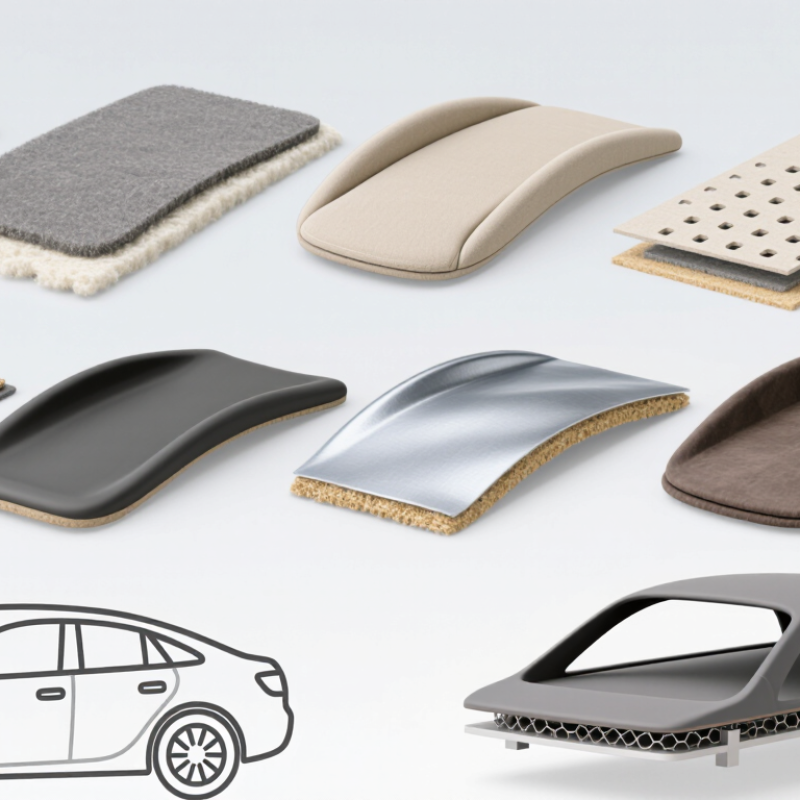
| 1 | Fabric-Faced Foam-Backed Liner | Knitted or woven polyester fabric with polyurethane foam | Decorative fabric laminated to a lightweight foam layer and a rigid roof substrate | Low weight, soft appearance, good acoustic absorption, and easy forming around roof contours | Foam can deteriorate with heat and age, causing fabric sagging or delamination | Passenger-car headliners and replacement roof liners |
| 2 | Needle-Punched Nonwoven Mat | Polyester, polypropylene, or blended synthetic fibers | Loose fibers mechanically entangled with needles, sometimes combined with a backing layer | Good sound absorption, economical production, low fiber shedding, and consistent thickness | Less premium tactile feel and limited resistance to harsh rubbing compared with woven fabrics | Roof insulation layers, utility vehicles, and cost-sensitive interior panels |
| 3 | Molded Fiber Roof Panel | Recycled or virgin polyester fibers, often with thermoplastic binder | Fiber mat is heated, compressed, and molded into a shaped, semi-rigid roof panel | Lightweight, dimensionally stable, recyclable in some systems, and suitable for integrated contours | Surface quality may require a decorative cover; repair of deep deformation is difficult | Large-area headliners and vehicles requiring lightweight structural interior panels |
| 4 | Polyester Felt Acoustic Mat | Dense polyester or PET acoustic felt | Compressed felt sheet, frequently die-cut or thermoformed to fit the roof structure | Strong mid- and high-frequency noise absorption, chemical resistance, and low moisture uptake | May require a separate decorative surface and can show compression marks | Acoustic roof layers, roof cavities, and exposed minimalist interiors |
| 5 | Woven Textile Roof Mat | Woven polyester, nylon, or polyester-blend yarns | Interlaced yarn fabric bonded to foam, felt, or a molded support panel | Attractive appearance, good abrasion resistance, and a wide range of textures and colors | Higher material and processing cost; stains can penetrate the textile structure | Higher-grade passenger-vehicle interiors and custom replacement liners |
| 6 | Microfiber Roof Liner | Fine-denier polyester or polyamide microfiber | Short, dense fibers attached to a foam, felt, or composite backing | Soft hand feel, refined visual texture, low light reflection, and good conformability | Can attract dust, show directional shading, and require careful cleaning | Premium-style headliners, pillars, sunroof surrounds, and custom interiors |
| 7 | Vinyl-Coated Foam Mat | Flexible PVC or thermoplastic vinyl with foam backing | Decorative vinyl skin laminated to foam and bonded to a shaped roof support | Easy to wipe clean, resistant to liquid spills, and available in smooth or textured finishes | Can become less flexible in cold conditions and may develop heat-related surface changes | Commercial vehicles, recreational vehicles, washable interiors, and utility cabins |
| 8 | Perforated Synthetic-Leather Mat | Perforated polyurethane-coated fabric or synthetic leather | Perforated surface layer laminated over foam or a nonwoven acoustic backing | Premium appearance, wipe-clean surface, and improved airflow or acoustic performance through perforations | Perforations can collect dirt, and excessive heat may affect the coating or adhesive | Sunroof areas, luxury-style interiors, and roof panels needing a leather-like finish |
| 9 | Molded Thermoplastic Roof Liner | Polypropylene, ABS, or other automotive-grade thermoplastics | Heated plastic sheet or molded compound formed into a rigid roof panel, with optional textile covering | High dimensional stability, precise mounting features, moisture resistance, and repeatable production | Lower inherent sound absorption and a harder surface unless additional acoustic layers are added | Vehicle platforms requiring integrated clips, wiring channels, handles, or lighting mounts |
| 10 | Reflective Insulation Roof Mat | Aluminized polymer film, closed-cell foam, and sometimes fiberglass or nonwoven backing | Multi-layer laminated sheet installed between the roof skin and the visible interior liner | Reduces radiant heat transfer, adds thermal insulation, and can help limit condensation | Usually needs a separate decorative liner and must be installed without compressing the insulation excessively | Hot-climate vehicles, vans, recreational vehicles, and roof retrofit projects |


 Your message must be between 20-3,000 characters!