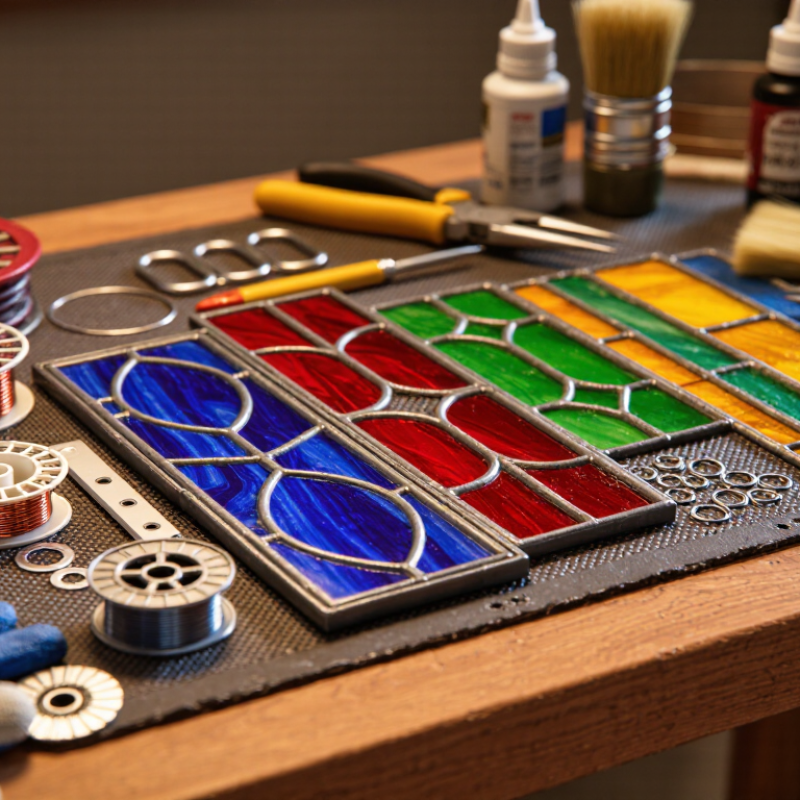
| Stained Glass Window Kit Components |
| Design | Pattern or Template | A full-size guide used to number, cut, and assemble each glass piece. The pattern normally includes seam allowances for the chosen construction method. | Usually included
Printed or downloadable pattern | A pattern helps maintain accurate shapes and consistent panel dimensions. |
| Glass | Colored or Textured Glass | Flat sheets of soda-lime glass selected for color, transparency, texture, and light transmission. Pieces are cut to match the pattern. | Often included
Preselected sheets or precut pieces | Glass edges are sharp and should be handled with protective equipment. |
| Cutting | Glass Cutter | A small hardened wheel scores the glass surface. The scored line creates a controlled path for breaking the glass. | Common in tool kits
Wheel cutter and cutting oil may be supplied | A score is not a deep cut; excessive pressure can cause unwanted breaks. |
| Shaping | Running Pliers and Grozing Pliers | Running pliers help open a scored line, while grozing pliers nibble away small irregularities and refine the edge. | Sometimes included
Frequently purchased separately | Use controlled pressure to reduce chips and accidental fractures. |
| Assembly | Copper Foil | Adhesive-backed copper tape is wrapped around the edges of individual glass pieces. The foil creates a metal surface that can be soldered. | Included in foil kits
Tape, burnishing tool, and pattern materials | Foil width should match the intended joint width and glass thickness. |
| Assembly | Lead Came | Lead came consists of H-shaped or U-shaped metal channels that hold glass pieces together. Sections are joined at intersections by solder. | Usually separate
Used for larger or traditionally styled panels | Lead came requires careful handling, clean work practices, and suitable ventilation. |
| Joining | Solder, Flux, and Soldering Iron | Flux helps solder flow over clean metal surfaces. A heated soldering iron melts solder to create permanent joints between copper-foiled or lead-came sections. | May be included
Often sold as an advanced-kit component | The iron and molten solder can cause burns; use heat-resistant and ventilated work areas. |
| Finishing | Patina and Finishing Materials | Patina chemically changes the color of solder or came, commonly producing a dark or aged appearance. Cleaning materials remove flux residue afterward. | Optional
More common in complete project kits | Follow the product safety instructions and protect nearby surfaces. |
| Safety | Protective Equipment | Safety glasses, closed-toe footwear, suitable gloves, and good ventilation help reduce risks from glass fragments, flux fumes, and hot tools. | Not always included
Should be prepared separately if absent | Safety equipment is part of the working setup, even when it is not packaged in the kit. |
| Main Stained Glass Techniques |
| Construction | Copper Foil Technique | Glass pieces are cut, their edges are wrapped with copper foil, and the foil-covered seams are soldered together. The method works well for intricate shapes and detailed designs. | Best for detailed panels
Common in beginner projects | The finished panel generally needs a rigid border or reinforcing structure. |
| Construction | Lead Came Technique | Cut glass pieces are fitted into metal channels. The channels are aligned and soldered at their joints, then cement or another waterproofing compound may be applied. | Best for traditional panels
Efficient for larger geometric sections | The design usually uses simpler shapes than copper-foil work. |
| Joining | Soldering | Soldering joins metal surfaces rather than bonding glass directly. Heat melts the solder, which cools into a solid seam after flowing across the prepared joint. | Required for foil and came
Needs an iron, flux, and solder | Clean metal, suitable heat, and controlled movement are essential for even seams. |
| Glass Decoration | Glass Painting and Enameling | Special glass paints or enamels are applied to the surface and fired in a kiln so the material bonds to the glass. They can add lines, shadows, details, or opaque areas. | Specialized technique
Requires compatible paint and kiln firing | Ordinary craft paint is not a substitute for kiln-fired glass color. |
| Glass Forming | Glass Fusing | Compatible glass pieces are placed together and heated in a kiln until they soften and fuse. Additional firing cycles can shape or flatten the result. | Separate kiln process
Not normally part of a basic window kit | Glass compatibility is critical because different expansion rates can cause cracking. |
| Surface Design | Etching and Engraving | Etching uses an abrasive or chemical process to create a frosted surface, while engraving mechanically removes or marks glass to form lines and textures. | Optional advanced work
Usually requires dedicated tools and controls | Chemical etching requires appropriate ventilation, protective equipment, and strict handling procedures. |


 Your message must be between 20-3,000 characters!