| Booth Configuration | Select cross-draft, semi-downdraft, downdraft, or side-draft construction according to vehicle size, workshop layout, and paint process. | Airflow design directly affects overspray control, finish quality, installation cost, and floor requirements. | Dimensioned drawings, airflow diagrams, foundation requirements, and installation layout. |
| Internal Working Dimensions | The clear internal length, width, and height should provide safe clearance around the largest vehicle and allow doors, hoods, and lift equipment to operate. | Insufficient clearance can create uneven coating, accidental contact, and restricted technician movement. | Final internal dimensions, maximum vehicle envelope, door opening size, and usable working height. |
| Airflow and Air Changes | The supplier should provide tested airflow volume, face velocity, pressure balance, and air-change calculations for the proposed booth. | Stable, uniform airflow helps move overspray toward filters and reduces dirt, turbulence, and finish defects. | Airflow test report, fan curves, design calculations, commissioning records, and pressure readings. |
| Filtration System | Use staged intake and exhaust filtration appropriate for paint solids, solvent vapors, and the selected coating process. Filters must be accessible for replacement. | Correct filtration protects the finish, fan system, workers, and surrounding environment. | Filter grades, pressure-drop data, replacement intervals, filter area, disposal guidance, and spare-part availability. |
| Heating and Curing | Verify heating capacity, temperature uniformity, maximum operating temperature, ramp-up time, and compatibility with waterborne or solvent-based coatings. | Uniform curing supports coating performance and helps reduce rework and cycle-time variation. | Heat-balance calculations, temperature-mapping results, burner or electric-heater specifications, and control logic. |
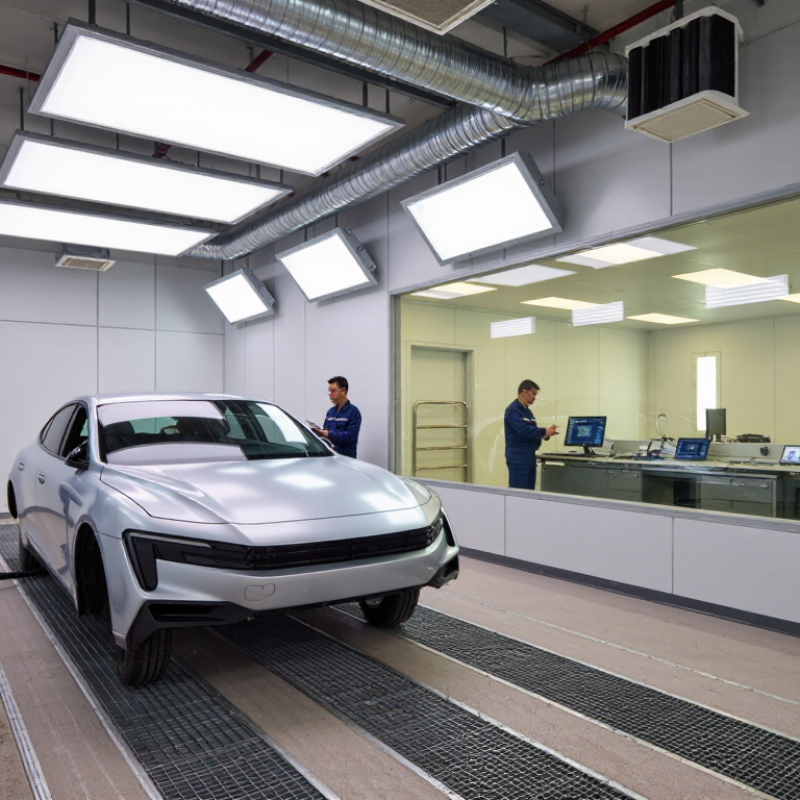
| Lighting Quality | Provide shadow-minimizing, evenly distributed lighting with a color-rendering specification suitable for color matching and surface inspection. | Consistent lighting makes metallic, pearlescent, and solid-color defects easier to identify. | Lighting layout, illumination measurements, color-rendering data, fixture ingress protection, and cleaning instructions. |
| Safety and Hazardous-Area Design | Electrical, ventilation, heating, and control components must be selected for the applicable hazardous-location requirements and local fire regulations. | Paint vapors and overspray can create fire, explosion, inhalation, and electrical hazards. | Electrical classifications, conformity documents, safety-risk assessment, fire-system interface, and local approval support. |
| Applicable Standards | Confirm compliance with the standards and codes applicable to the installation country, such as NFPA 33 in the United States or relevant EN, ATEX, electrical, and workplace-safety requirements in other markets. | Compliance affects legal operation, insurance, worker safety, and project approval. | A standards matrix identifying the exact edition, clause, certificate, and responsibility for local permitting. |
| Energy Consumption | Compare fan motor power, heater input, heat-recovery options, standby controls, and operating energy per paint cycle rather than comparing purchase price alone. | Energy use is a major part of the total cost of ownership, especially for high-throughput facilities. | Rated electrical or fuel consumption, duty-cycle assumptions, estimated annual operating cost, and energy-monitoring method. |
| Controls and Monitoring | The control system should monitor temperature, operating mode, alarms, filter condition, fan status, and emergency shutdown functions. | Clear controls improve repeatability, troubleshooting, and operator safety. | Control-panel specification, alarm list, wiring diagrams, data-logging capability, software access, and training plan. |
| Build Quality and Materials | Assess panel construction, corrosion resistance, seals, doors, floor grating, filter frames, fasteners, and cleanable interior surfaces. | Durable and cleanable materials help maintain airflow performance and reduce contamination over the booth life. | Material specifications, panel thickness, coating system, corrosion protection, load ratings, and quality-inspection records. |
| Installation and Commissioning | Evaluate whether the supplier provides site surveys, mechanical and electrical installation guidance, start-up, balancing, testing, and operator training. | Professional commissioning is essential to achieve the performance shown in the proposal. | Project schedule, installation scope, commissioning checklist, acceptance criteria, and responsibility matrix. |
| Maintenance and Spare Parts | Prioritize suppliers that provide preventive-maintenance schedules, common replacement parts, technical manuals, and documented service procedures. | Accessible parts and service reduce unplanned downtime and help preserve safety performance. | Parts list, lead times, service coverage, maintenance intervals, warranty exclusions, and remote-support process. |
| Total Cost of Ownership | Calculate purchase, freight, installation, permitting, utilities, filters, maintenance, training, downtime, and end-of-life costs over the planned service period. | The lowest initial quotation may have higher operating and maintenance costs. | Itemized quotation, five-year or ten-year cost model, utility assumptions, consumables pricing, and renewal terms. |
| Supplier Capability | Compare relevant vehicle-refinish installations, engineering resources, manufacturing quality controls, financial stability, references, and after-sales response capacity. | A capable supplier is more likely to deliver a compliant system and support it throughout its operating life. | Reference projects, factory-quality procedures, service-area coverage, customer contacts, delivery history, and warranty-performance records. |


 Your message must be between 20-3,000 characters!