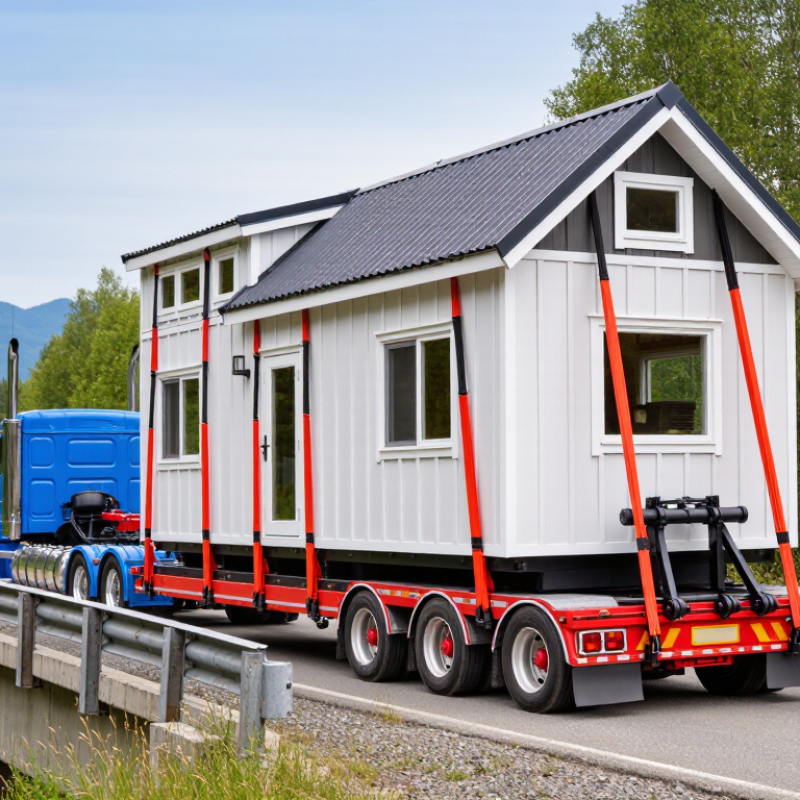
| North America | Specialist manufactured-home, modular-building, or heavy-haul mover with route-survey capability | Towable chassis, gooseneck or fifth-wheel transport, lowboy trailer, or flatbed | Road-legal width is commonly planned around approximately 8.5 ft in the United States, but state and provincial limits vary | Oversize permits, escort requirements, utility-line checks, bridge reviews, and state or provincial routing may apply | Strong availability of pilot-car coordination, crane or forklift support, blocking, leveling, and utility-disconnection services | Very strong |
| European Union and EEA | Abnormal-load haulier experienced with modular units, low loaders, and cross-border movement | Low-loader, extendable trailer, flatbed, or self-propelled modular transporter for larger units | Many European road rules use approximately 2.55 m as a standard vehicle-width reference, with national exceptions and permit thresholds | National permits, route studies, escort vehicles, toll planning, and border documentation may be required | Good access to route engineering and cross-border logistics; narrow streets, historic bridges, and urban restrictions require early planning | Very strong |
| United Kingdom and Ireland | Abnormal-load transporter familiar with rural access, bridge restrictions, and utility coordination | Low-loader, rigid trailer, articulated trailer, or specialist modular transport equipment | Width and length above ordinary road limits can trigger abnormal-load procedures; local roads often become the practical constraint | Advance notification, police or escort arrangements, bridge checks, traffic management, and local authority coordination may be needed | Strong planning capability, but hedges, stone walls, low bridges, roundabouts, and narrow lanes require a physical route survey | Very strong |
| Australia and New Zealand | Heavy-haul or house-relocation operator with long-distance route, escort, and site-placement experience | Prime mover with low-loader or platform trailer; self-move is generally limited to purpose-built towable units | Australia commonly uses 2.5 m as a general vehicle-width reference, while state and territory rules determine oversize treatment | State or territory permits, escort vehicles, travel-time conditions, infrastructure checks, and route approvals may apply | Good specialist capability; remote distances, unsealed access roads, tree clearance, and weather can materially affect the plan | Very strong |
| East Asia | Urban logistics or modular-construction transporter with compact equipment and precise delivery scheduling | Flatbed, low-loader, container platform, or crane-assisted modular transport | Vehicle-size rules are jurisdiction-specific; compact dimensions and low overall height are especially important in dense urban areas | Road occupancy permits, restricted-hour delivery, police or traffic coordination, and building-site approvals may be required | High urban logistics capability, but limited staging space, overhead infrastructure, and tight access can make crane placement essential | Strong with planning |
| Southeast Asia | Project cargo or modular-building mover with local traffic knowledge and adaptable loading equipment | Flatbed, lowbed, truck trailer, barge connection, or crane-assisted movement depending on island and road access | Local road geometry, axle limits, bridge capacity, and overhead cables often matter more than national vehicle limits | Local authority permissions, port or ferry coordination, traffic control, and route-by-route approvals may be required | Service capability varies by country; pre-move inspection and local subcontractor verification are particularly important | Moderate to strong |
| Middle East | Project-logistics or heavy-haul provider capable of desert routes, industrial-site deliveries, and crane coordination | Lowbed, extendable trailer, flatbed, or modular transporter; port-to-site delivery is common for imported units | Overall height, axle loading, and turning radius must be checked against urban structures, bridges, and industrial entrances | Transport permits, police or escort coordination, customs documents, port release, and site access approvals may apply | Strong large-project logistics; heat, sand, long distances, and limited final-site infrastructure require careful scheduling | Strong with planning |
| Latin America | Regional heavy-haul or modular-construction mover with customs and local-permit support | Lowboy, flatbed, container platform, or multimodal road-and-port transport | Bridge ratings, road surface, steep grades, urban congestion, and overhead utilities must be checked on the exact route | Federal, state, provincial, or municipal permits may overlap; customs and border documents are relevant for international moves | Capability is strongest around major freight corridors and ports; remote or mountainous destinations need additional contingency planning | Moderate to strong |
| Africa | Project-cargo or heavy-haul mover with local route knowledge, port handling, and recovery capability | Flatbed, lowbed, modular transporter, rail or barge connection, and crane-assisted delivery where available | Road surface, bridge capacity, seasonal weather, clearance, and final-kilometre access are central planning factors | National and local permits, border or customs procedures, escort arrangements, and site security coordination may be required | Service availability differs considerably by country; a physical survey, spare-equipment plan, and weather contingency are recommended | Selective by corridor |


 Your message must be between 20-3,000 characters!